Wednesday, 15 May 2019

Loving Vincent (2017)


PG, BreakThru Productions, 94 mins.


The first ever hand-painted film, this tells the largely uncharted story of the infamously reclusive painter Vincent Van Gogh - through using the medium he became synonymous with.

  Constructed entirely out of oil paint, a team of thousands of animators from all over the world painstakingly create a world of trains, sun-dappled landscapes and many - quite literally - colourful characters.

 Not a lot is known about this enigmatic figure, even less about the events which occurred directly after his death. How much is dramatised is an open question, but it makes for an interesting, if not always gripping, narrative device nonetheless.

 Boyish detective Armand (Douglas Booth) meets a varied array of individuals to try and deduce exactly how a troubled and often volatile Van Gogh, died under suspicious (or perhaps not so suspicious) circumstances.

  Booth has had a phenomenal slate of roles to his name over the last few years. From playing Boy George, to privileged party boys Harry (The Riot Club) and Anthony (Agatha Christie’s And Then There Were None) and a flamboyant Vaudevillian impresario in this autumn’s criminally underrated serial-killer chiller The Limehouse Golem, he’s a versatile, polished and incredibly focused actor - and Armand is no exception. Relatable, subtle and unassuming, it’s another performance which absolutely anchors the film.

  There is also a Poldark reunion, with Aidan Turner and a particularly brilliant, very natural Eleanor Tomlinson as the daughter of the owner of a provincial cafĂ©.

‘You want to know so much about his death, but what do know of his life?’ inquires an aloof maid.

  There may not always be a great deal of substance or new information about our deliberately elusive titular character.

However, it’s executed in such a genuinely state-of-the-art way, that the mechanisms of the plot somehow become incidental to the artistry. The dazzling images are always alive with movement too: faces change expression, looking temporarily perplexed with incredulity. The actors are filmed using revolutionary motion-capture technology: photographed as normal, with the computer matching their every mannerism. But, as this great achievement demonstrates, innovation coupled with traditional methods work the best…


Rating: * * *


Sunday, 10 March 2019

Coco (2018)

PG, 105 Mins, Pixar.

The latest from animation powerhouse Pixar, there’s a wonderfully old-fashioned, moral, Disney feel to Coco - yet it feels simultaneously fresh. Young Mexican boy Miguel has a unrequited passion for music - his family dismiss his artistic talent ever since a family descendent abandoned them years ago to pursue his own dreams of being a musician.

When the guitar inside the statue of his local celebrity idol magically comes to life, Miguel is transported to the phantasmagorical irreverence of The Land Of The Dead, where he must get back to the living, and discover the true meaning of how family lasts forever…

The animation is technically extremely rich, full of little moments of slapstick, particularly in the world of the afterlife - eye-sockets retract and jaws fall off.

But it’s the emotional, human touches of affection which really resonate. For example, the title itself refers to the oldest living member of Miguel’s family - Grandma Coco. Well into her hundreds, the lines and wrinkles on her face are rendered with such minutia of detail and texture, that there were moments - as so often happens with computer-animations, where my disbelief was so suspended that I believed that these characters were really people - and was completely emotionally captivated.

It’s also thankfully very telling in its timing and themes. Along with tackling quite difficult, universal thematic material for children: life, death, forgiveness etc, it’s also somewhat of a much-publicised statement against the separation-politics which presently loom over us. With diversity currently such a hot-button topic, this is one of the first mainstream animations ever to have an almost entirely Latino cast. There are nods to making a stance against both Trump and Brexit, even a reference to immigration control, but all treated subtly enough as to not be too heavily ladled-on. It’s so refreshing to see a Hollywood studio make such a celebratory film about embracing another culture so fully.

This joyousness is evident in the glorious songs, from the Frozen lyricists, notably Remember Me, which will have many parents misty-eyed by the end. A delight - bound for Oscar glory.


Rating: * * * *


Murder On The Orient Express (2017)


114 Mins, 12A, 20th Century Fox.


Just as the poster for the famous 1974 version of what is arguably Christie’s most famous mystery, showcased its stars faces like a Cluedo-esque comic-strip cartoon, this one has had equally starry publicity, for a cast that contains some of our finest actors of all time.

 Sir Kenneth Branagh directs, co-writes, and also stars as Poirot, that fastidious perfectionist of a Belgian detective. Twelve strangers meet, and become stranded on the famous train, then one of them is brutally murdered…

Johnny Depp plays Edward Ratchett, a notoriously nasty gangster, absolutely terrifically - surly, slimy and relentless, but in such a subtle way. Depp dosen’t actually have that much screen-time, or that many lines, but actually has a couple more scenes than Richard Widmark did in the original.

One is a very interesting, lust-strewn exchange between himself and Michelle Pfeiffer, also extremely good, but again, as with Depp, underused, as the domineering, serial divorcee - Mrs Hubbard, previously played by Lauren Bacall.

The other key scene for Depp, is his famous confrontation with Poirot, when he asks unsuccessfully for his help. It’s discussed over what looks like a caramel pastry dessert, which Ratchett demolishes with frustration…

There are some fantastic sequences, namely a central set-piece where the train itself derails completely, with everybody falling out of their beds, as a lightening storm releases a giant avalanche…

Not everyone is well cast. Mary Debenham, the governess brilliantly  played by Vanessa Redgrave before, is now played by Star Wars’s Daisy Ridley, - far too young to convince in the the role. Josh Gad, as Ratchett’s assistant McQueen, fails to capture that nervous energy that Psycho’s Norman Bates himself - Anthony Perkins, brought to the role.

The biggest miscast is Branagh himself, majorly over-egging the accent and mannerisms as Poirot - his performance is pure caricature. 

Character names and professions have been changed. Sean Connery’s Colonel Arbuthnot from the original, is now a doctor. The car salesman, who was called Foscarelli, has now become the Spanish Mr. Marquez, played with fantastic, gregarious benevolence by Manuel Garcia-Rufo.

Stylish, and very entertaining. 


Rating: * * * *


Kingsman 2: The Golden Circle (2017)

15, 141 Mins, Twentieth Century Fox. 


In 2015, director Matthew Vaughn made the first Kingsman film: it was gloriously unapologetic in the irreverence of its own subversiveness. It knows, as Vaughn does, exactly which elements it’s sending up. So much so that there’s even a scene in the original between Colin Firth’s dapper gentlemen spy and Samuel L. Jackman’s lisping, baseball-capped megalomaniac, where they discuss the many iterations of the spy genre itself. ‘Nowadays they’re all a little serious for my taste…give me a far-fetched theatrical plot any day’.

Now, all the on-the-button self-referentiality coupled with a knowingly nostalgic whip-smart screenplay gets a sequel.

The second chapter in a proposed trilogy, is even more over-the-top, flashier, brasher, and gratuitous than the first one. The only element that’s given a comic-book tone-down this time, is the speed-ramped violence: there’s no equivalent of the infamous church massacre from the original.

 We’re back in spy extravagance from the opening scene: an spectacularly staged sequence in a London taxi.

Eggsy, our charismatic young spy, must tackle everything from deadly bionic arms, to American rivals and lethal cable-cars, all with sharp orange tuxedos, acerbic one-liners and its tongue firmly inside its cheek.

Taron Egerton as Eggsy, is so confident and funny delivering all of the above, that he really could be a Bond of the future, effortlessly having much more personality than Daniel Craig. These movies wouldn’t be nearly as entertaining without him at the centre.

Starry new recruits are given nothing to do: Halle Berry and Jeff Bridges are both frustratingly stuck behind desks. While this film definitely works significantly less well than the original in terms of sheer surprise, shock or invention - it has an even better villain - another terrific performance from Julianne Moore as Poppy, the deceptively sunny proprietor of a fifties-style diner with a ruthlessness behind her veneers. In her words: ‘Kingsman is crumpets!’. Why ruin it with a gimmicky cameo from Elton John, and lewdness which makes it impossible to determine who it’s aimed at. It’s far too jammed with expletives for younger children, and also too much off an obviously mainstream comic-book spectacular to appeal to more mature adults. Not as streamlined, self-referential or as strikingly original as the first one. Can’t wait for the next two though!


Rating: * * * *


Monday, 4 March 2019

The Greatest Showman (2017)


2017, PG, 20th Century Fox, 105 Mins.

Casting Hugh Jackman as P.T. Barnum, the very first man of show-business, is a perfect match. Jackman started his career in Oklahoma! at London’s National Theatre before becoming synonymous as the clawed superhero Wolverine in nine X-Men movies. 
 The most recent of those, Logan, decidedly became very gritty, but The Greatest Showman is thankfully much happier fare: lighter, brighter, much more fun. 
In fact, I would argue it’s even a grand return to the more classical, traditional MGM Gene Kelly-style musicals of the fifties, ones which we haven’t really seen on screen for a while, such as Singin' In The Rain or An American In Paris. The fantastic score and joyous musical numbers have such an expert sense of glossy spectacle - so much so, that afterwards, even though it’s a deeply cinematic experience - because it’s also unashamedly theatrical, you feel as if you’ve just been to the theatre. Seamus McGarvey’s panoramically swirling cinematography, captures everything from trapeziums, to elephants and CGI lions, all encompassed within Nathan Crowley’s effortless production design. This theatricality, hits the audience like a shot of adrenaline from the dramatic opening shots - drum beats, Barnum in silhouette, directly addressing the audience, singing: ‘Ladies and gents, this is the moment you’ve waited for’. Those unaccustomed to the stumbling block musicals have, of characters suddenly bursting into song and not stopping, may take a while to acclimatise. 
The score itself, is written by the same lyricists of last award-season’s crowd-pleaser, La La Land, however I think this is a far more captivating film. 
It’s a score studded with rich textures of emotional resonance, showcasing fantastically assured performances, not just from a deservedly Golden Globe-nominated Jackman, but also a terrific Michelle Williams as his wife Charity, who’s been hiding this astounding voice, for her numbers A Million Dreams and Tightrope. My favourite, is Never Enough, the profoundly moving centrepiece for opera starlet Jenny Lind, portrayed brilliantly by Rebecca Ferguson.
  One of the very best films of 2017.

Rating: * * * *


Thursday, 21 February 2019

Fantastic Beasts: The Crimes Of Grindelwald (2018)


Not only do blockbuster franchises have sequels, prequels and reboots, but luckily for the colossal fandom, the latest emerging trend, is the extended universe or spin-off. Marvel, DC and Star Wars have all ventured into continued iterations of their expansive milieu, and now comes the second instalment in JK Rowling’s evolution of Harry Potter’s Wizarding World. 
After the events of the first Fantastic Beasts in 2016, proceedings inevitably take not only a much darker, but also far more complex turn. It’s even more elaborate, magical, ambitious and visually dazzling than its predecessor. Rowling’s imagination is as boundless as ever, with a whole bundle of new characters, intersecting plotlines and idiosyncratic creatures.
  This descent into the aforementioned far darker territory, is thankfully due to the much bigger role taken by Johnny Depp, returning as the grandiose arch antagonist of the title, Gellert Grindelwald. Depp is absolutely terrific - oozing relentless malevolence, but still retaining this incredibly persuasive capacity to manipulate. Still sporting a shock of blonde hair and haunting eyes that change colour, the film opens in spectacular style, as he engineers a high-octane escape from prison, then plans to eradicate the world of ‘No-Maj’s’ (muggle, or ‘non-magical’ souls)…
 Meanwhile, it’s up to gifted but awkward wizard Newt Scamander, played by Eddie Redmayne (once again a rather bumbling, one-note performance) to stop him. He believes the key may be in ascertaining the whereabouts of troubled orphan Credence (a very empathetic Ezra Miller) who’s desperate to discover the truth about his identity…
Narratively, this chapter strikes the perfect balance between originality and nostalgia. It feels simultaneously utterly fresh, with entirely new echelons of danger, and a tone which hits doomily dramatic heights at times. But also, there are extremely clever references strewn throughout to the beloved, tangibly familiar Potter canon. These include the much-anticipated return to Hogwarts – during which a gleefully exciting portion of John Williams’s signature theme is reprised. As well as a wonderous new score, prolific composer James Newton-Howard subtly intertwines these classic motifs throughout (listen as the 3D Warner Bros. logo floats towards you!)
There’s a young Dumbledore, portrayed by Jude Law – unlikely casting, but he does capture an enigmatic, mercurial quality. 
  The swirling, panoramic cinematography by Philippe Rousselot, immerse the viewer firmly into the action. Stuart Craig’s richly detailed production design – statues move, champagne pops, several artefacts from previous films appear – and Colleen Atwood’s sumptuous costumes, only add to the magic. 
 Giving nothing away, the final scene contains an unbelievably audacious revelation – which sets up tantalisingly for what’s to come next!...

Rating: * * * *


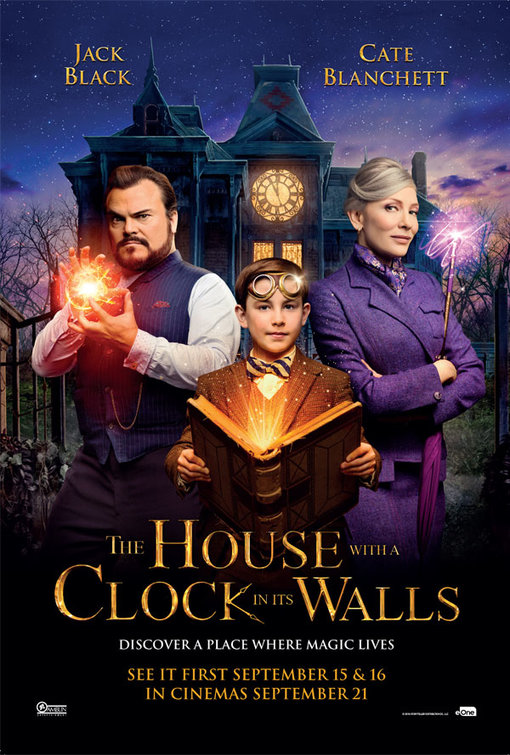
The House With The Clock In Its Walls

It’s interesting to think, that a genre once so fertile in the eighties and nineties – the mainstream family fantasy that wasn’t necessarily a sequel or franchise – has now, all but disappeared. The likes of The Addams Family, The Borrowers and Mousehunt, ended with Nanny McPhee, and has since been foreshadowed by animation, or live-action remakes of known quantities.Now, extreme horror director Eli Roth (Hostel), is looking to revive it, with a film that is now a Hollywood rarity: a family horror-fantasy, squarely aimed at the pre-teen, ‘tween-age’ audience. Based on the 1973 novel of the same, rather perplexing name by John Bellairs (more of a bestseller in the US than the UK, it tells the rather well-worn story of Lewis (Owen Vaccaro – endlessly irritating and over-acting horribly throughout), an orphaned outsider who goes to stay in a mysterious, ancient mansion containing a lifetime of secrets, under the stewardship of a wizard, his uncle Jonathan (Jack Black) and his eccentric next door neighbour, Mrs. Zimmerman (Cate Blanchett – wonderful, and poised-in-purple, but given so little to do).The film itself is a decidedly mixed Halloween-themed bag of too few tricks and not enough treats either, but what I admire about its ambition at least, is Roth’s desire to recapture that aforementioned lost genre: a mainstream effects-laden family fantasy.Tellingly, it’s distributed by Spielberg’s company, Amblin (watch out for the nice touch of its E.T.-inspired logo in its original eighties form. That inimitable Amblin spirit of funny-and-scary-but-not-too-frightening essence of Goonies meets Gremlins, is exactly what this film admirably strives to recalibrate. Many critics have cited Harry Potter, but I think it far more closely resembles the undeterminable strangeness and ambiguity of Lemony Snicket, Dark Shadows, Monster House or Goosebumps – in which Black also stars.Really, it only partly succeeds. It’s fun, but as with so many films trying to balance laughs and scares – it’s not funny nor scary enough. It’s purely personal, but I’ve never found Jack Black remotely funny. Johnny Depp or James Franco would’ve been far better – but would’ve needed far sharper dialogue. The script should zing and sparkle, but it’s nowhere near as polished as it should be. There’s something so airlessly hollow about the whole atmosphere; the pacing should float - it often feels plodding and all so inconsequential.There’s plenty of effects magic which could’ve been pushed further, but there are some great moments, including a brilliantly ghoulish Kyle MacLauchlan, and a fantastically staged attack, reminding us: never to trust pumpkins…

Rating: * * *